

In the era of the digital economy, data has become a critical factor of production; however, security risks associated with data storage and the lack of a disaster recovery system are posing a major threat to business continuity for enterprises and organizations. Traditional on-premises plaintext storage and software-only cloud backup solutions often prove highly vulnerable when faced with sophisticated cyberattacks or ransomware.
Once hackers gain control of an operating system through system vulnerabilities or administrator credentials, software-based antivirus and backup tools can easily be silently disabled, tampered with, or formatted, resulting in backup copies being compromised or even permanently destroyed.How can we eliminate the security blind spots caused by peer-level software permissions at their root and establish an impenetrable baseline for data storage?
I. The Inherent Dilemmas of Traditional Software Backups: Permission Mismatches and Hidden Corruption
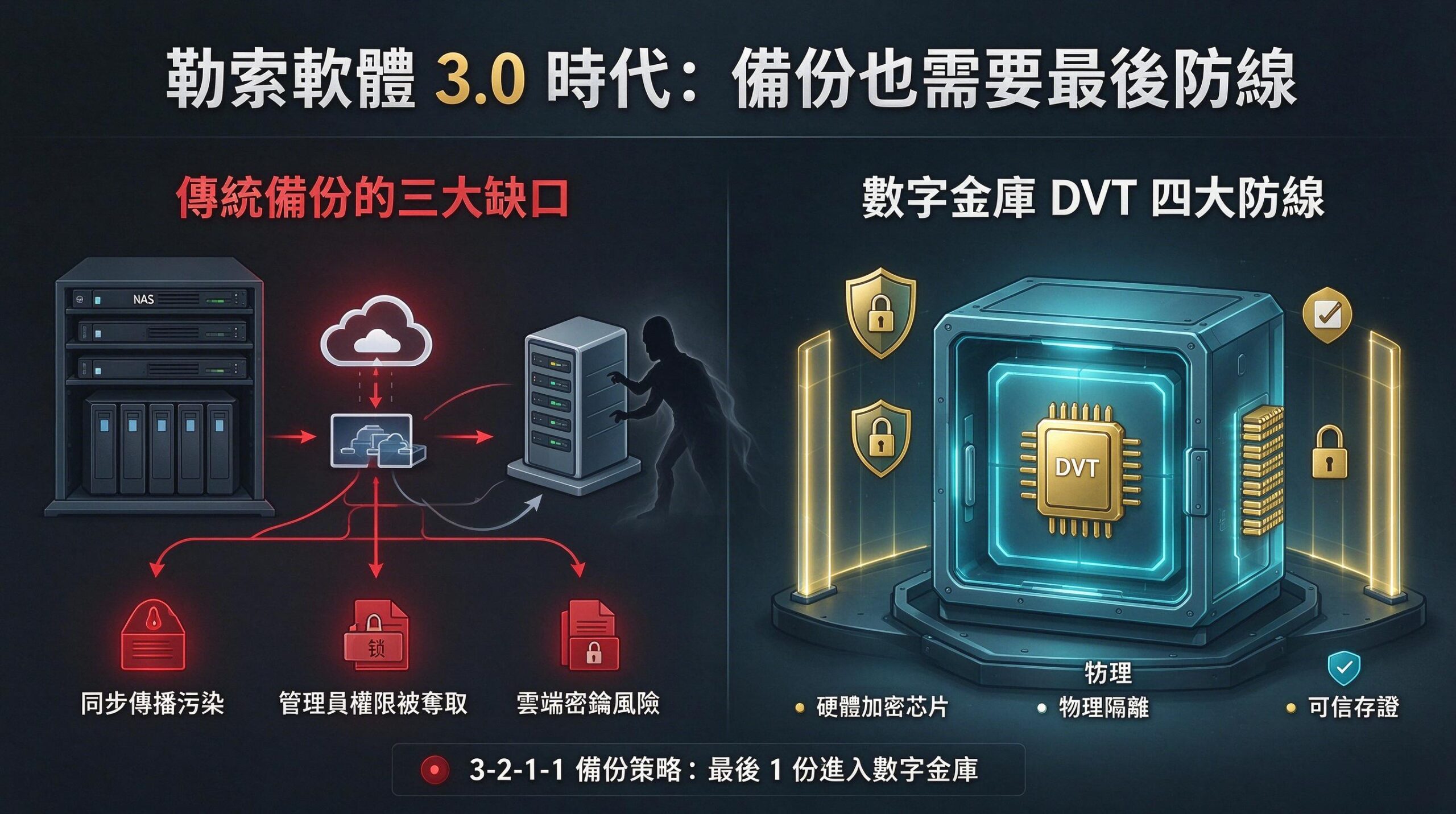
In corporate digital operations, data storage faces three risks: “overt leakage,” “covert corruption,” and “disaster recovery failure”:
- Logical Collapse Under Equal Permissions: If a hacker or malicious insider gains root or administrator privileges on the operating system, they can directly terminate the backup agent service or even format the local and cloud backup partitions.
- Lack of hardware-level encryption protection: Many companies still rely on local plaintext storage or encryption software without hardware key protection; if a certificate is compromised, the stored data is at risk of being directly exposed.
- “Paper-Based Disaster Recovery” and the Hidden Risks of Bad Blocks: Traditional disaster recovery systems often suffer from excessively long backup windows and a lack of early warning for physical or logical bad blocks, resulting in the discovery of corrupted backup files and failed restores only after a disaster has occurred.
To break the deadlock of this “software game,” the only way forward is:Move data tamper protection, key management, and backup and recovery logic to a “hardware-based cryptographic facility and network boundary isolation layer” that is beyond the reach of hacker software.
II. Breaking the Digital Vault (DVT) Impasse: Post-Quantum Cryptographic Facilities and Dual-Factor Authentication Using Both Hardware and Software
As a professional cloud disaster recovery and backup solution and a core hub for secure storage, Digital Vault not only provides encrypted data hosting and tiered access control but also leverages a cloud architecture to build a backup system capable of intelligent failover and rapid data recovery.
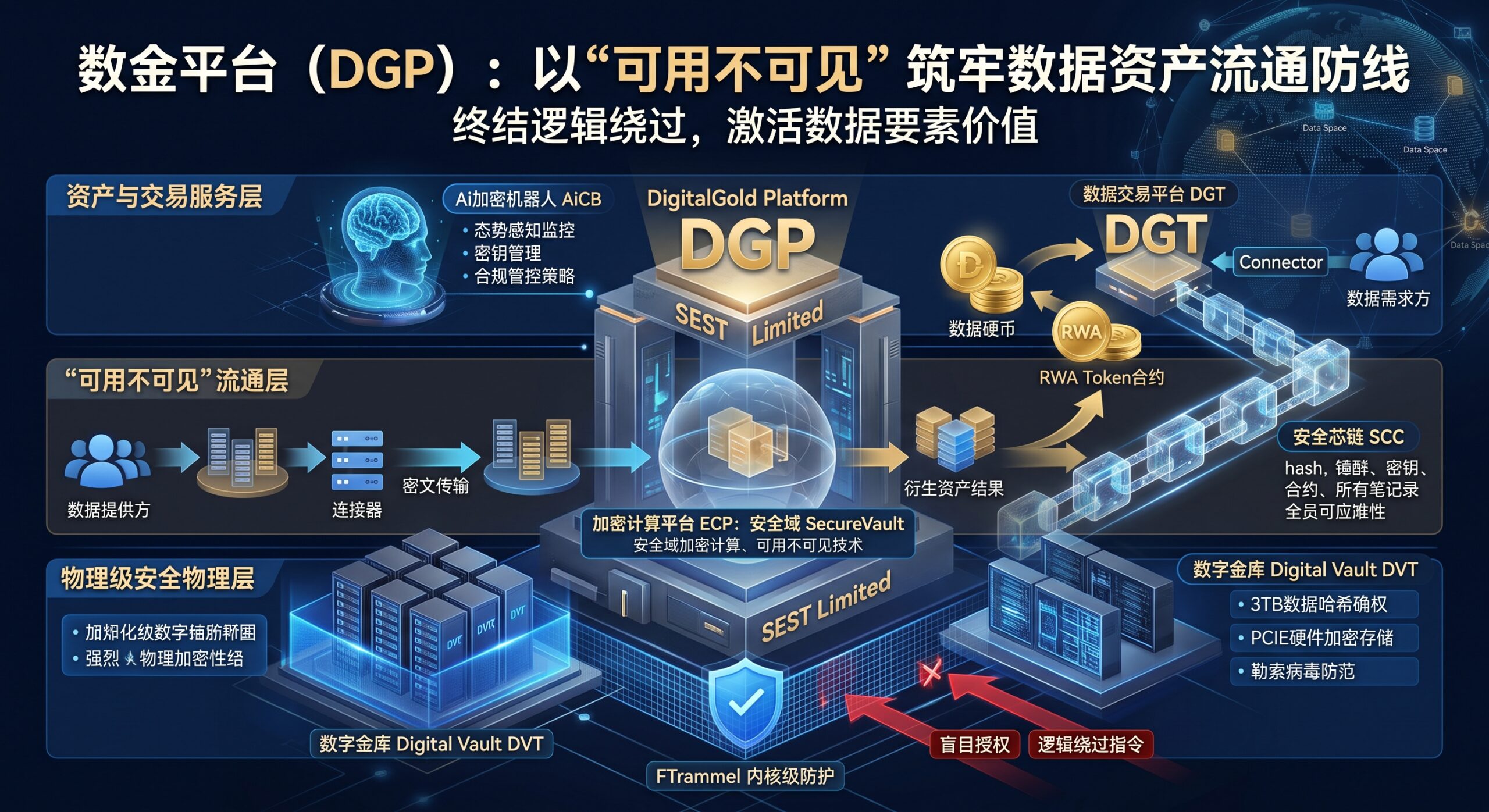
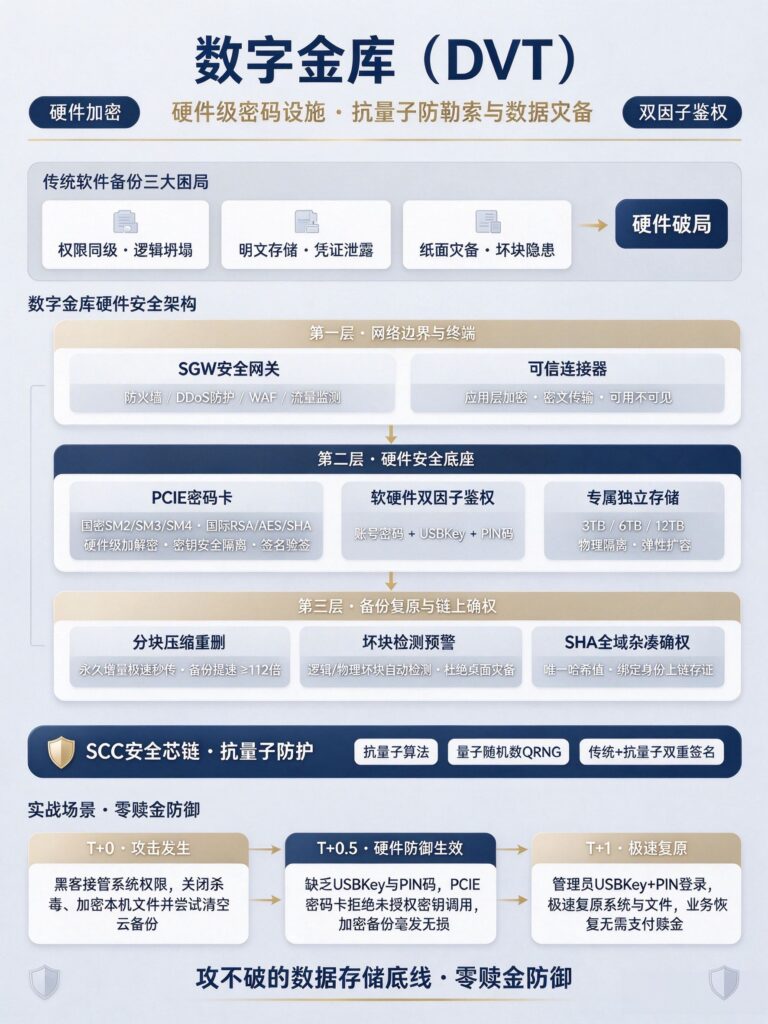
Digital Finance Platform (DGP) Network Perimeter and Endpoints – SGW Security Gateway (Firewall/DDoS Protection/WAF/Dynamic Traffic Monitoring) – Trusted Connector (Application-Layer Encryption/Ciphertext Transmission/Visible but Not Accessible) |
Digital Vault (DVT) Hardware Security Platform – PCIe Cryptographic Card (hardware-based encryption and decryption using national and international algorithms, key management, and digital signing and verification) – Username and password + USBKey + PIN (combined hardware and software two-factor authentication) – 3 TB of enterprise-customized, dedicated storage space (physically isolated and flexibly scalable) |
Data Backup and Recovery & On-Chain Verification Mechanism – Block-based compression with deduplication & permanent incremental backup for ultra-fast transfers (at least 112 times faster) – Mechanisms for Detecting and Issuing Early Warnings for Logical and Physical Bad Blocks – SHA Global Hash Calculation -> SCC Security Core On-Chain Evidence Storage |
1. PCIe Cryptographic Card: Hardware-Level Encryption and Key Security Management
The Digital Vault integrates high-performance cryptographic hardware—PCIe Password Card:
- High-Performance Encryption, Decryption, and Computation: Fully supports Chinese national cryptographic algorithms (SM2, SM3, SM4, etc.) and internationally recognized algorithms (RSA, AES, SHA, etc.), providing hardware-level encryption for data storage, backup, and transmission. Hardware-level processing chips significantly improve efficiency, effectively alleviating computational pressure in high-concurrency backup and transaction scenarios.
- Golden Key Security Isolation: Features a built-in module for generating, storing, and destroying security keys, preventing key leakage in memory or at the software layer, and ensuring secure key invocation for digital vaults and encrypted computing platforms.
- Security Certification and Signatures: Provides hardware-level data signing and verification capabilities to ensure data integrity and tamper-resistance throughout the entire storage and transmission process.
2. Hardware and Software Licensing: Multi-Factor Access Control
Digital Vault employs a “login ID + password + USBKey (PIN)” authentication model, combining software and hardware to manage operator roles and enforce access controls in the backend. Even if a software-level password is stolen, an attacker cannot configure or tamper with backup and recovery tasks without the physical USBKey and PIN code authorization. 3. Dedicated, Independent Storage Space
Digital Vault allocates independent, dedicated storage space to users in 3TB increments (e.g., 3TB, 6TB, 12TB, etc.). It builds a secure storage architecture based on Digital Vault servers to ensure physical data isolation and storage flexibility.
III. Ultra-Fast Disaster Recovery, Bad Block Early Warning, and Global Hash Verification
Digital Vault has not only established a robust security foundation but has also achieved innovation in backup and recovery performance as well as asset verification and title confirmation:
- Block-Based Compression, Duplicate Removal, and Ultra-Fast Transfer: Performs deduplication and compression of data on the backup client, saving storage space without affecting backup and restore speeds. By automatically optimizing and consolidating backups, it backs up only the files that have been modified,Increase backup speed by at least 112 times。
- Multi-Type Recovery and Bad Block Warning: Supports various types of recovery methods, including operating system backup and recovery, as well as file system backup and recovery. It features a built-in bad block detection and early warning mechanism that automatically detects logical and physical bad blocks in data files and issues timely alerts, thereby preventing “paper-only disaster recovery.”
- Global Hash-Based Ownership Verification and E-Coin Generation: Based on a user’s exclusive 3TB dataset stored in the digital vault, a global hash calculation is performed using the SHA algorithm—the same one used for data verification—to generate a unique and tamper-proof hash value. By linking the hash value to the user’s identity, the process is completed. SCC Secure Core Chain Through notarization, corresponding virtual currency (E-coins) is generated in accordance with the contract rules, thereby achieving unique anchoring and title confirmation for data assets.
IV. Boundary Protection, Encrypted Channels, and Post-Quantum Security
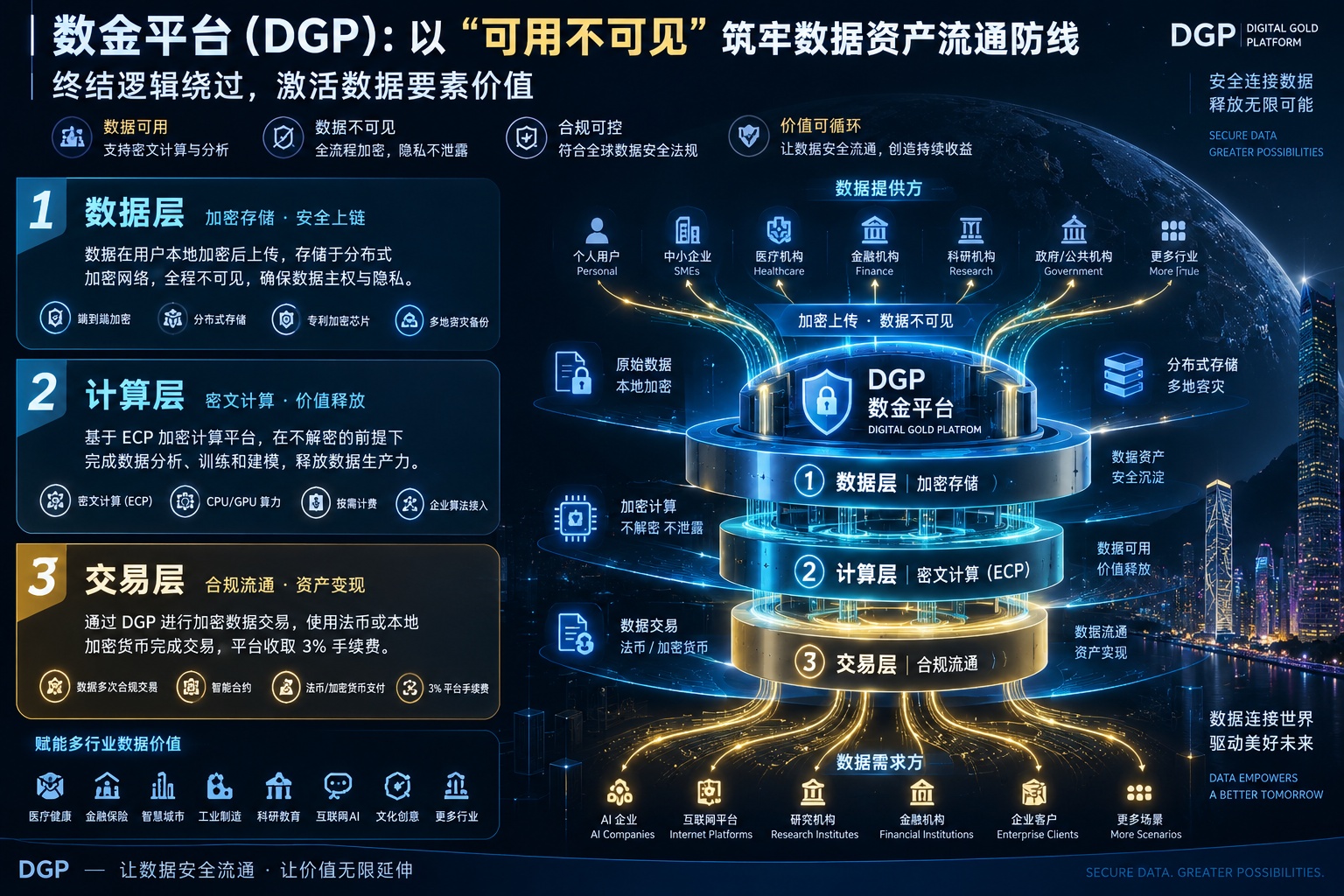
To ensure the security of connections between the Digital Vault and other modules—such as the Data Trading Platform (DGT), the Encrypted Computing Platform (ECP), and the Computing Power Center—the system has implemented multiple layers of protection:
- SGW Security Gateway: As a security barrier at the network perimeter, it integrates firewall access control, threat protection, WAF capabilities, and traffic forwarding. It supports IP and MAC binding, DoS/DDoS protection, ARP attack protection, virus scanning and removal, and real-time monitoring to block unauthorized access and various types of network attacks.
- Trusted Connector: Deployed on the data provider’s or user’s end devices, it features built-in data encryption and format validation. Data is transmitted in encrypted form throughout the entire process, achieving the privacy protection goal of “usable but not visible” and mitigating the risk of interception during transmission.
- SCC Secure Chip Chain: Quantum-Resistant Protection: The SCC underlying blockchain, which enables the integration of data on-chain for evidence preservation, has integratedPost-quantum encryption algorithms与Quantum Random Number Generator (QRNG), utilizing a dual-signature scheme combining “traditional signatures and post-quantum signatures” to ensure that transaction signatures and on-chain data evidence remain tamper-proof and unbreakable even in future quantum computing environments.
V. Real-World Scenarios: How Professional Organizations Achieve “Zero Ransom” Defense
Take law firms, accounting firms, high-tech R&D companies, or financial institutions, for example; the core assets of such organizations are confidential case files, audit working papers, and core code repositories:
- T+0 hours (time of the attack): Hackers gain access to internal network servers through phishing emails or system vulnerabilities, force the local antivirus software to shut down, encrypt local files, and attempt to delete standard cloud backups.
- T+0.5 hours (hardware protection takes effect): Hackers attempted to compromise the backup task, but because they lacked the physical USBKey and PIN for authentication, and the PCIe password card rejected unauthorized key calls, the encrypted backup in the digital vault remained completely intact.
- T+1 Hours (Ultra-Fast Recovery):IT Administrator inserts an entity USBKey and enter PIN By logging into the Digital Vault Management Platform and utilizing block-level synthesis and ultra-fast recovery mechanisms, the system and files were restored in a very short time, allowing business operations to resume smoothly,Don't pay hackers a single penny in ransom。
Feel free to contact our data security experts to schedule an appointment. 1-on-1 Evaluation of Hardware-Level Data Ransomware Resistance With a live demonstration of SES DVT, apply an indestructible “digital seal” to your company’s core assets.
💡 In-Person Experience and Exclusive Assessment Appointments:
- Product Technical Specifications and Solution Inquiries: https://secures.hk/
- 官方服務信箱:info@secures.hk

DVT Digital Vault · Over 20 years of experience in post-quantum encryption technology—securing data sovereignty, starting now.